Introduction
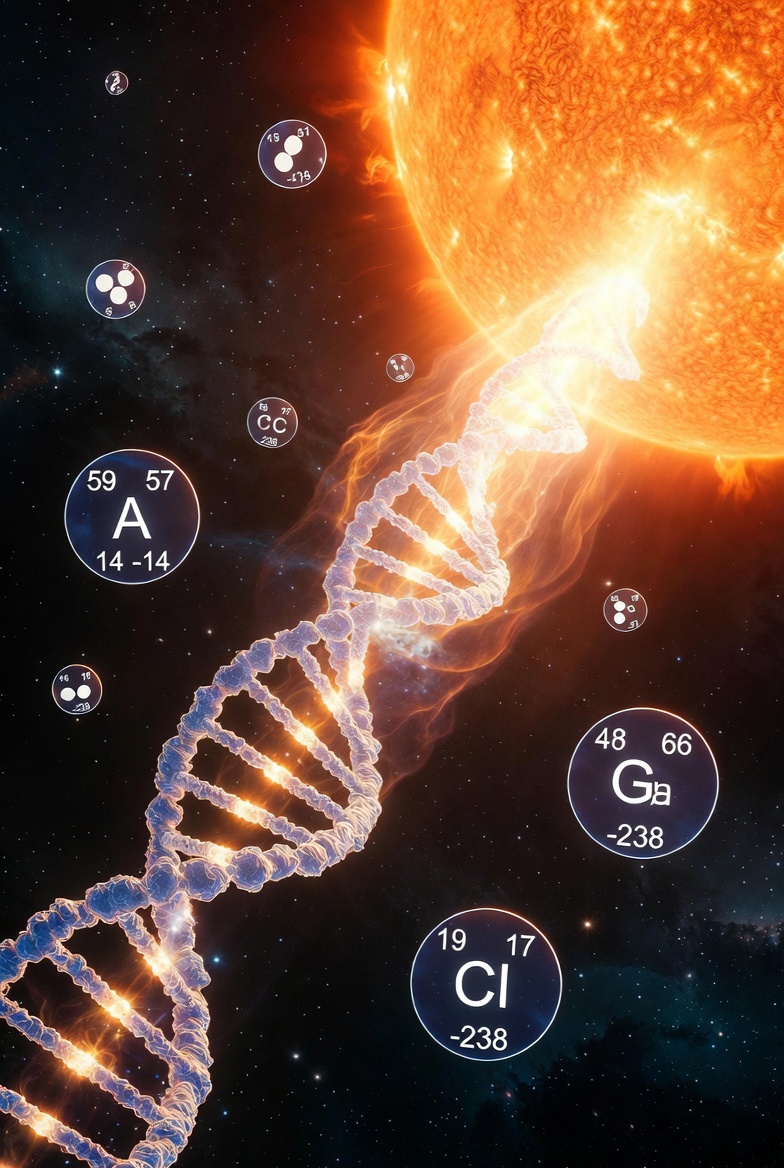
The Sun is more than just a distant star providing light and warmth—it’s a dynamic powerhouse that shapes life on Earth in profound ways. From the dazzling displays of the Northern Lights triggered by solar flares to disruptions in satellite communications during intense solar storms, our closest star constantly reminds us of its reach. But what if the Sun’s activity goes even deeper, influencing the very building blocks of matter? In this thought experiment, I hypothesize that heightened solar activity could potentially “energize” isotopes in periodic elements, shifting them to higher energy levels. This, in turn, might mutate human DNA—perhaps even incorporating an exotic form like “Carbon 7″—and awaken untapped abilities hidden within our genetic code. While this idea ventures into speculative territory, it’s inspired by intriguing scientific debates about solar effects on radioactive decay. Let’s explore the evidence, the science, and the possibilities.
Scientific Background on Decay Rates
The notion that solar activity might affect radioactive decay rates challenges a cornerstone of physics: the assumption that these rates are constant. In the late 2000s and early 2010s, researchers like Jere Jenkins and Ephraim Fischbach from Purdue University observed puzzling correlations. For instance, data from Brookhaven National Laboratory on the beta decay of Silicon-32 (32Si) and from Germany’s Physikalisch-Technische Bundesanstalt on the alpha decay of Radium-226 (226Ra) showed slight annual variations—faster decay in January-February (when Earth is closest to the Sun at perihelion) and slower in July-August (at aphelion). These changes were tiny, less than 1%, but they aligned with the Earth’s orbital cycle, suggesting a solar link.Further studies added intrigue. During a major X-ray solar flare on December 13, 2006, decay rates of Manganese-54 (54Mn) dipped noticeably, starting 36-40 hours before the flare itself. Peter Sturrock at Stanford University also noted correlations with the Sun’s 33-day core rotation period, proposing that uneven neutrino emissions from the Sun might influence decay. Neutrinos, those elusive particles produced in solar fusion, were floated as a possible culprit, though their weak interactions make this controversial. Alternative explanations pointed to variations in scalar energy fields or zero-point energy in space, potentially modulated by the Sun’s mass or activity.However, balance is key: Later high-precision experiments, such as those by the National Institute of Standards and Technology (NIST) in 2016, scrutinized multiple isotopes and found no such oscillations. Upper limits on variations were set as low as 0.0006%, attributing earlier anomalies to environmental factors like seasonal temperature or humidity affecting lab instruments. Today, the consensus holds that decay rates are stable under Earth conditions, with no proven solar modulation. Still, those initial findings open a door for speculation—what if under extreme solar conditions, larger effects could emerge?
Extending to Isotope Shifts
Building on this, could solar activity cause widespread “isotope shifts” to higher energy levels across elements? In theory, solar particles like neutrinos or high-energy protons from flares might interact with atomic nuclei, exciting them or altering decay paths. The Purdue team’s work hinted at this through proximity effects, while ideas from physicists like John Barrow and Duncan Shaw suggest the Sun could tweak fundamental constants, like the electromagnetic fine-structure constant, via scalar fields. Barry Setterfield, referenced in creation science discussions, extends this to zero-point energy fluctuations, proposing that the solar system’s motion through space might amplify such changes. Yet, evidence for broad shifts is scant. Nuclear excitations require targeted energy inputs, not the diffuse influence of solar activity. Solar neutrinos pass through Earth mostly unimpeded, and while flares boost proton fluxes, they don’t systematically “upgrade” isotopes en masse. My hypothesis imagines an intensified scenario—perhaps during a solar maximum or super flare — where cumulative effects could push isotopes like carbon or others in the periodic table to metastable states. This is purely speculative, bridging observed micro-variations to macro possibilities, but it draws from the article’s call for research into larger scalar field disturbances, like those from gravity waves or supernovae.
DNA and Human Evolution
Now, let’s connect this to biology. We know the Sun impacts DNA directly through ultraviolet (UV) radiation, which can cause mutations by forming thymine dimers or generating reactive oxygen species that damage genetic material. Solar activity influences this indirectly; during high-activity periods, the Sun’s magnetic field better shields Earth from cosmic rays, but it can also thin the ozone layer, increasing UV exposure. This has real consequences—elevated solar cycles correlate with higher skin cancer rates, but mutations are also evolution’s engine, driving adaptations over generations.Pivoting to speculation: If solar-driven isotope shifts occurred, particularly in carbon—the backbone of DNA and organic molecules—it could alter bond strengths or energy configurations. Human DNA relies overwhelmingly on Carbon-12, with traces of Carbon-13; Carbon-14 is unstable and used for dating, not structure. But “Carbon 7”? This isotope (with just one neutron) is hyper-unstable, decaying in femtoseconds—it’s not viable in biology. Still, as a metaphor for exotic change, imagine solar-energized carbon isotopes integrating into DNA, subtly shifting molecular vibrations or electron orbits. This might “activate” junk DNA or dormant genes, unlocking abilities like enhanced intuition, resilience, or even latent psychic potentials often relegated to science fiction. Think solar-powered heroes in comics, where stellar energy triggers superhuman traits. Of course, this lacks empirical backing—mutations from radiation are random and often harmful—but it’s a fun “what if” rooted in real Sun-DNA interactions.
Implications and Caveats
If such a mechanism existed, the upsides could be transformative: Heightened cognition, faster healing, or adaptive evolution in response to cosmic cycles. During the upcoming Solar Cycle 25 peak (around 2025-2026), we might fantasize about a global “upgrade” fostering human advancement. But caveats abound—uncontrolled mutations could lead to chaos, like increased genetic disorders or ecological disruptions. The changes in decay rates observed were minuscule; scaling to DNA-altering levels would require unprecedented solar events, risking more immediate threats like power grid failures.This is all hypothetical, emphasizing the need for rigorous research. Future studies on neutrino detectors, space probes, or quantum gravity might uncover links, but for now, treat this as exploratory musing, not settled science. We should monitor solar activity through agencies like NASA, but avoid pseudoscientific leaps.
Conclusion
The Sun sustains life through photosynthesis and warmth, but its activity may hold deeper mysteries. From subtle decay rate hints to wild speculations on isotope shifts and DNA mutations, our star could be a catalyst for untapped human potential. Whether “Carbon 7” becomes a reality or remains sci-fi, pondering these connections reminds us of our place in the cosmos—dependent on, and perhaps transformed by, the Sun’s eternal dance.
Sources for further reading:
- Evidence for Correlations Between Nuclear Decay Rates and Earth–Sun Distance (Jenkins & Fischbach, 2009)
https://www.sciencedirect.com/science/article/pii/S092765050900084X
(This is the key paper analyzing data from Brookhaven and PTB labs, showing annual variations tied to Earth-Sun distance.) - Perturbation of Nuclear Decay Rates During the Solar Flare of 13 December 2006 (Jenkins & Fischbach, 2009)
https://www.sciencedirect.com/science/article/abs/pii/S092765050900070X
(Reports decay rate changes linked to a specific solar flare, with pre-flare effects.) - arXiv Preprint: Evidence for Correlations Between Nuclear Decay Rates and Earth-Sun Distance (Jenkins et al., 2008)
https://arxiv.org/abs/0808.3283
(Early version of the above, freely accessible, discussing fluctuations correlated with orbital distance.) - The Strange Case of Solar Flares and Radioactive Elements (Symmetry Magazine / Stanford Report, 2010)
https://www.symmetrymagazine.org/breaking/2010/08/23/the-strange-case-of-solar-flares-and-radioactive-elements
(Popular summary covering Sturrock’s work on neutrino flux and decay rate variations.) - Variable Radioactive Decay Rates and the Changes in Solar Activity (Creation.com article summarizing Jenkins/Fischbach and Setterfield)
https://creation.com/en/articles/radioactive-decay-rates-and-solar-activity
(Directly matches the text you originally provided, with references to the Purdue findings and solar neutrino ideas.)
Balancing / Refuting Evidence (Consensus View of Constant Decay Rates)
- Evidence Against Solar Influence on Nuclear Decay Constants (Pommé et al., NIST-led, 2016)
https://www.nist.gov/publications/evidence-against-solar-influence-nuclear-decay-constants
(High-precision study setting tight upper limits on variations, attributing anomalies to environmental factors.)